
Economics of AI
Measuring Value Before It Disappears
A decade ago, United Parcel Service launched ORION, a system designed to optimize delivery routes. The concept was straightforward; reduce unnecessary milage, minimize left hand turns, and improve delivery sequencing. The theoretical economics were transformative.
UPS estimated that eliminating one mile per driver per day could save $50 million annually. As ORION scaled, the company reported millions in savings each year, lowering fuel consumption and operational expenses. Over time, the route adjustments compounded into hundreds of millions in savings.
Despite the significant savings and operational efficiencies, value never appeared as a new revenue stream or product launch. There was no line item dedicated to AI investments. The benefits were embedded within their margins, distributed across thousands of other decisions and initiatives.
UPS is among a small group of organizations that has publicly quantified the economics of its AI investments. Considering ORION was launched in 2015, it’s fair to say, they were ahead of their time. As organizations accelerate spending on artificial intelligence, boards and management teams should begin considering how returns will be captured.
Despite meaningful improvements in forecasting, personalization, pricing, fraud detection, and operational efficiency, AI’s economic impact will be difficult to isolate and defend. MVPs and pilots often demonstrate technical feasibility but rarely capture economics at scale.
Why AI Value Disappears
Traditional investments produce visible benefits including, new facilities, new products, or cost reductions. AI investments, however, present differently. They generate value through distributed optimization rather than discrete events.
A pricing model may increase margin by 30bps. A churn model may reduce attrition by 20%. A fraud system may lower loss rates by fractions of a percent. Individually, these improvements are modest. At scale however, they can transform a business.
In the absence of disciplined attribution, they are absorbed into aggregate financial performance. Senior executives see improving margins or better growth, yet they cannot confidently trace the improvement back to a capability. Over time, as initiatives compound, clarity often diminishes. The risk to organizations is lack of visibility to the processes which are meaningfully contributing to economic value. The unlock is sophisticated measurement and monitoring.
The Three Economic Layers of AI
To measure AI properly, leaders must distinguish among three forms of economic value:
1. Efficiency
The most obvious layer, this includes automation of manual processes, reduction in cycle time, and lower operational error rates. Efficiency value is typically easiest to quantify, but it captures only a portion of AI’s economic contribution.
2. Optimization
Optimization value arises when AI improves the quality of decisions across pricing, marketing, inventory planning, credit underwriting, or supply chain management. These improvements compound over time but are often embedded in overall financial results. Without statistical models and controls, optimization gains become indistinguishable from general performance improvement.
3. Strategic Optionality
Strategic optionality is the most subtle but offers the greatest competitive advantage. AI systems can create new capabilities that enable future revenue streams or improve competitive advantage. While personalization engines, loyalty optimization, and dynamic pricing may not result in immediate revenue benefits, they increase operational performance.
Winning organizations will need to devise strategies to invest in all three areas, including embedding a strong measurement capability to quantify value.
Leading Indicators Precede Financial Results
Many organizations continue to rely on lagging financial metrics because they are familiar and broadly understood. However, these measures are poorly suited to capturing distributed AI value.
By the time revenue or margin effects are visible from AI initiatives, attribution will be a challenging endeavor. Dozens of confounding initiatives make it difficult to attribute without highly sophisticated models.
Effective AI governance begins with tracking leading indicators that signal capability scaling:
Percentage of eligible decisions automated
Revenue or cost base influenced by AI systems
Reduction in decision cycle time
Forecast accuracy improvements
Model adoption rates across business units
These metrics obviously do not represent financial value directly. They indicate whether the organization is building economic leverage.
Lagging indicators like margin expansion, revenue lift, cost reduction, loss avoidance remains essential. But without leading indicators, leaders often discover too late that AI capability has stagnated or remains underutilized.
A Practical Framework: The AI Value Scorecard
To prevent value from turning into aggregate performance metrics, organizations need a structured approach to AI economics. The Nerdy Executive proposes an AI Value Scorecard which integrates operational, financial, and governance measures into a single oversight framework.
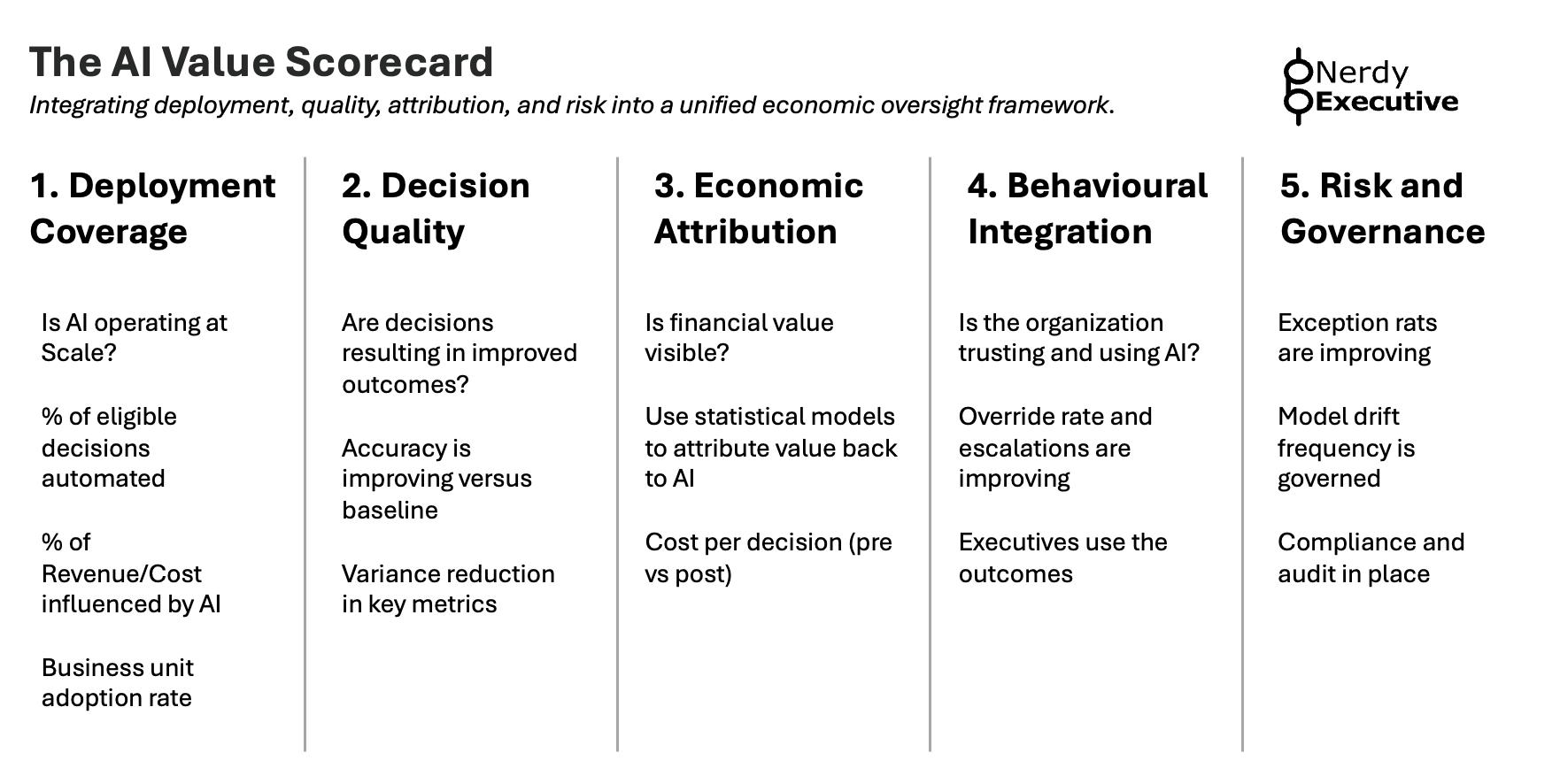
1. Deployment Coverage
Measure scale of adoption. Without scale, economic impact remains constrained.
2. Decision Quality Improvement
Measures whether AI meaningfully improves decisions.
3. Economic Attribution
Connect technical performance to financial outcomes.
4. Behavioral Integration
Monitor override rates since they signal value leakage or incentive misalignment.
5. Risk and Governance Indicators
Constantly check for risks implement oversight.
Together, these dimensions provide a systemic view of AI performance. They move the conversation beyond “Does the model work?” to “Is AI creating durable economic leverage?”
The Real Shift in AI Economics
AI fundamentally changes the marginal cost of decision making. Once deployed, the incremental cost of executing one additional optimized decision approaches zero. This creates operating leverage but only if decisions align with strategy and adoption is real.
Organizations that treat AI as a series of isolated projects will struggle to defend sustained investment. Those that measure its influence across systems, incentives, and economics will compound advantage.
The lesson from UPS and similar operators is not simply that AI can save money. It is that disciplined measurement makes value visible. AI is not a business unit, it’s a multiplier. Multipliers only matter when your organization understands it’s starting position and implements measurement frameworks to quantify economic value.
